







§1Products
Four products, a fabrication lab and our open-source work, each in its own room.
Each one plugs into a tool or step your team already uses: regulations, behavioural analysis of streets and stores, modelling in Rhino, sketch to 3D and large-scale robotic 3D printing. HAI, our open-source project, lets you direct an AI agent with your hands, face and voice.
- 01
AEC Agent
ProductAn evidence workspace for building regulations.
Ask about your project and see which rules apply, how they connect, and where each one is written.
- 02
Behavioural Analysis
ProductHow people really use streets, stations and stores.
Behavioural Analysis turns ordinary camera footage into evidence for design. People are anonymised on the device, tracked through the space and mapped onto your floor plan or site plan, so footfall, dwell and flow sit on the same drawing you design on. For urban projects it reads squares, streets and transit hubs; for retail it reads entrances, aisles and displays.
- 03
Rhino Agent
ProductA design team of agents, working inside Rhino.
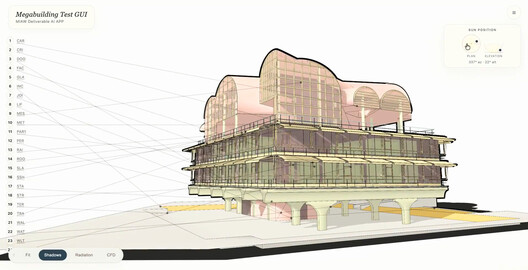
Rhino Agent is built around how architectural and urban practices actually work. You brief it the way you would brief your studio. A planning agent reads the model and the brief, breaks the work down, and hands it to specialist agents: a designer for form and massing, a detailer for components and resolution, and a landscape agent for the ground and site. Each one works directly in your Rhino file, and you can review, revise or stop any step.
- 04
Sketch 2 3D
ProductFrom a hand sketch to a 3D model.
Photograph a sketch and get a massing model you can open, measure and keep working on.
- 05
Ortus
LabLarge-scale architectural 3D printing.
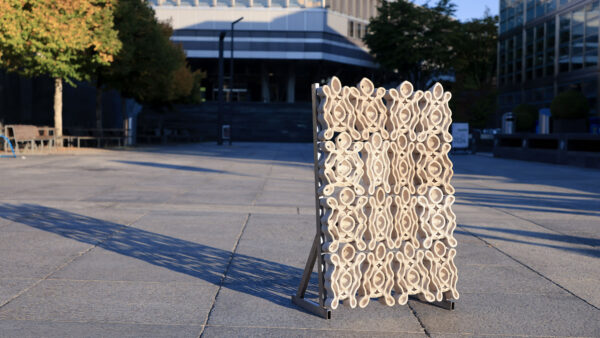
Ortus is our fabrication lab. A robotic arm prints clay and ceramic at architectural scale, and a bank of desktop printers turns out models, moulds and parts.
- 06
HAI
Open sourceHands, face and voice for AEC agents.
HAI, the Human AI Interface, lets you direct an AI agent and your design software with your hands, face and voice, using only a laptop webcam. Point at a wall, say “make it 300 thick”, nod to accept. Tracking runs in your browser and the camera video never leaves your machine. HAI is open source and built in public, with a new stage every week.
Every product in its own room. Drag to look around.
§2About
We make design workflows better, not different.
SPAIRL is an accelerator for architecture, engineering and construction. Practices have workflows that work: the drawings, the models, the reviews, the people. We don’t replace them. We add AI and technology inside them, in Rhino, on the plan, on site, so the same work gets done faster and with fewer mistakes.
Every product starts from a problem we met in practice, and we test it on real projects with architects, developers, engineers, retailers and public bodies before it becomes a product.
- 2.1
Architecture
Design tools that read sketches, plans and codes, so more of the studio’s time goes into the design itself.
- 2.2
Engineering
Agents and analytics that check, model and measure, with every result traced to its source.
- 2.3
Construction
Fabrication and on-site technology, from robotic clay printing to sensors that show how buildings are used.
§3Founders
Five architects and computational designers.
All five founders trained at the Institute for Advanced Architecture of Catalonia (IAAC) in Barcelona. Between us we cover architecture, urban planning, AI research and digital fabrication. Read our story →
-
 01
Samarth Pachchigar
Architect, urban planner, AI researcher
Master’s in AI for Architecture and the Built Environment at IAAC. Before that, a project architect in Surat and a consultant at Cushman & Wakefield in Mumbai.
LinkedIn ↗ -
 02
Nihal Sadique
Architect, computational designer
Retail, commercial and residential architecture in Kerala, then Advanced Architecture at IAAC. Now an architect in Dubai.
LinkedIn ↗ -
 03
Nihal Mannath
Architect working with graphs and AI
Graph RAG on building regulations, ecological corridors, and graph neural networks to find food deserts. AI researcher at Henning Larsen in Hamburg.
LinkedIn ↗ -
 04
Prashant Vaghasiya
Architect, computational designer
3D printing and digital fabrication in architecture. Interned under Yatin Pandya in Ahmedabad and studied 3D printing architecture at IAAC.
LinkedIn ↗ -
 05
Sahil Yousaf
Architect and AI researcher
Computational design, geospatial AI and LLM agents. Built an agentic data layer on a Neo4j spatial graph at City Layers in Vienna. Earlier at Morphogenesis in Bengaluru.
LinkedIn ↗
§4Questions
What people ask us.
What is SPAIRL?
SPAIRL is an accelerator for the AEC industry (architecture, engineering and construction), headquartered in Surat, India. We build AI and technology that fits into the workflows practices already use: agents for building regulations and for modelling in Rhino, behavioural analysis of how people use streets and stores, sketch-to-3D, and large-scale robotic 3D printing.
Does SPAIRL replace our design software?
No. Our products work inside the tools and steps your team already uses: your Rhino file, your floor plans, your building regulations, your site. The aim is the same work done faster and more accurately, not a new way of working.
What is the SPAIRL AEC Agent?
AEC Agent is an evidence workspace for building regulations. Ask about your project and it shows which rules apply, how they connect, and the clause each answer comes from. It runs at aec-agent.spairl.si; access is by invitation.
What does Rhino Agent do?
Rhino Agent is a team of AI agents that works inside Rhino. A planning agent reads your brief and the model, then hands the work to specialist agents for design and massing, detailing, and landscape. Every step happens in your Rhino file and can be reviewed, revised or stopped.
Does Behavioural Analysis identify people?
No. People are anonymised on the device. Behavioural Analysis turns ordinary camera footage into footfall, dwell and movement data, mapped onto your plan, for urban spaces such as streets, squares and stations, and for retail stores.
Is HAI free to use?
Yes. HAI, the Human AI Interface, is SPAIRL’s open-source project under the Apache-2.0 licence. It lets you direct an AI agent and your design software with your hands, face and voice through a laptop webcam. The code is on GitHub and the project is built in public at hai.spairl.si.
Where is SPAIRL based?
Our head office is in Surat, Gujarat, India, and we also work from Mumbai, Calicut (Kozhikode) and Dubai.
How do I try a SPAIRL product?
Write to management@spairl.si or book a call from this site. AEC Agent is available by invitation at aec-agent.spairl.si, and HAI can be downloaded from its GitHub releases.
§5Locations and contact
Surat, Mumbai, Calicut and Dubai.
- Surat Gujarat, India · Head office 21.1702° N · 72.8311° E
- Mumbai Maharashtra, India 19.0760° N · 72.8777° E
- Calicut Kerala, India 11.2588° N · 75.7804° E
- Dubai United Arab Emirates 25.2048° N · 55.2708° E
management@spairl.si